EAK TTV: A Key Tool for Accurately Simulating DIMM Heat Generation and Accelerating Server Thermal Validation
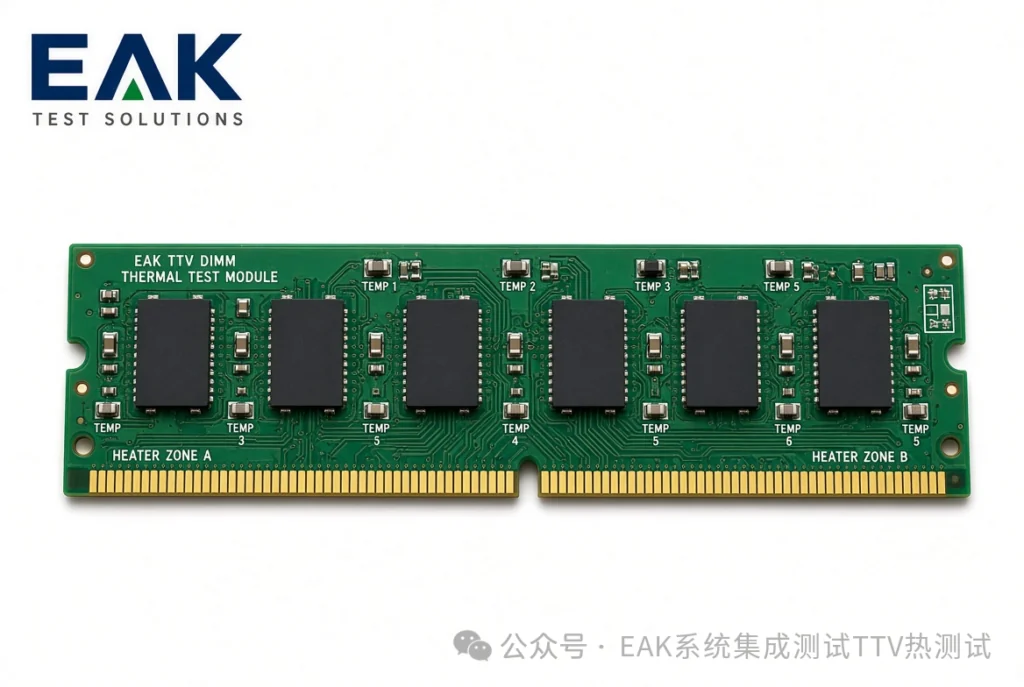
Driven by AI and high-performance computing (HPC), server power density keeps rising. Besides CPUs and GPUs, DIMMs have become a major heat source. When multiple high-bandwidth DDR5 modules run in parallel under full load, they generate substantial heat. Insufficient cooling can easily trigger throttling, degraded stability and even system failures. The TTV (Thermal Test Vehicle) launched by EAK is designed to mimic the thermal characteristics of real DIMMs, enabling engineers to efficiently complete thermal validation at the design stage.
Why Use TTV to Simulate DIMM Heat Generation?
Real DIMMs are costly and limited in quantity. It is difficult to precisely control their power consumption and temperature distribution under extreme loads or during early prototyping. Thermal testing with functional chips carries the risk of burnout, and test results are hard to reproduce. As a thermal twin tool, the EAK TTV can safely and controllably replicate thermal behavior before mass production of actual DIMMs or high-risk testing.
Key application scenarios:
- Server OEM/ODM thermal solution validation Evaluate the performance of airflow channels, memory heat sinks and liquid cold plates under full-load operation of multiple DIMMs.
- Data center and rack-level testing Work with CPU/GPU TTVs to simulate system-wide thermal loads and optimize liquid or air cooling architectures.
- Early design iteration Identify hotspots and thermal resistance issues before high-power real memory becomes available, shortening development cycles.
Public research (such as papers on TTV design for server memory modules) also indicates that as power density in data centers increases, pre-simulating thermal loads of future hardware with TTVs is essential for developing new cooling solutions.
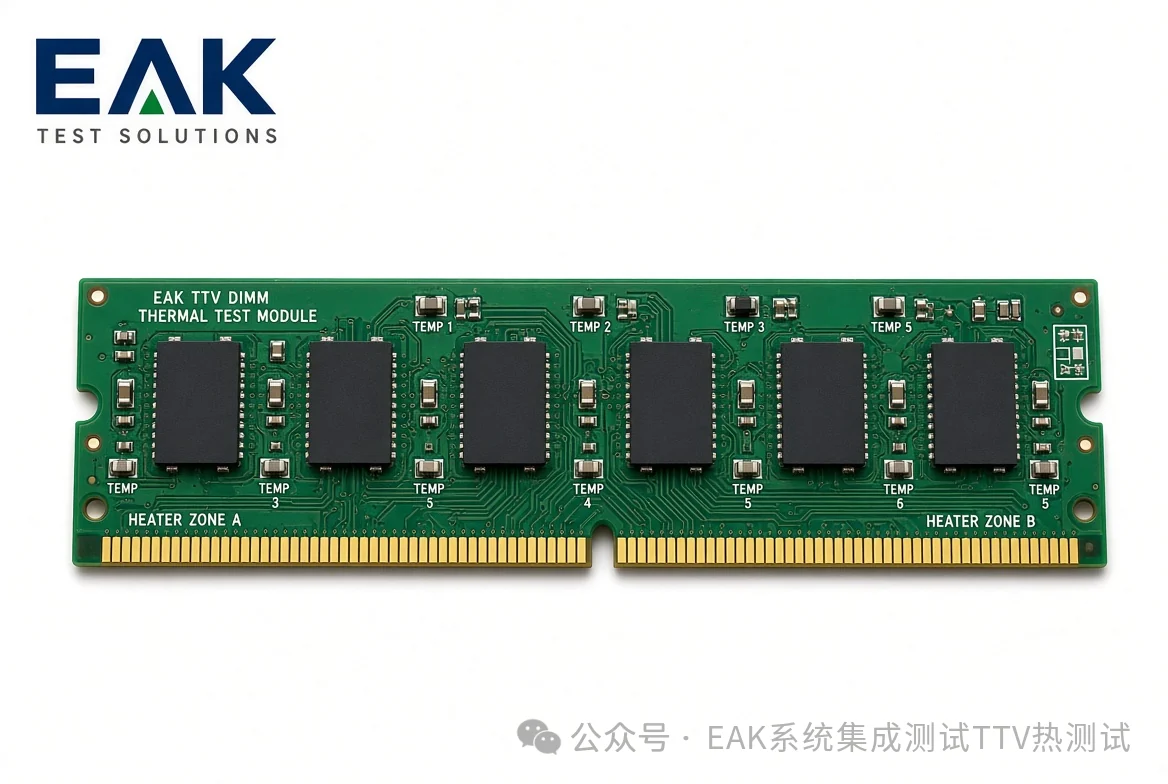
在AI与高性能计算(HPC)推动下,服务器功耗密度持续攀升。CPU、GPU之外,内存(DIMM)也成为重要热源。高带宽DDR5模块在满载运行时,多根并行工作会产生显著热量,若散热不足,易导致降频、稳定性下降甚至系统故障。EAK推出的TTV(Thermal Test Vehicle,热测试载具)专门用于模拟真实DIMM的发热特性,帮助工程师在设计阶段高效完成热验证。
为什么需要用TTV模拟DIMM发热?
真实内存条价格高、数量有限,且在极端负载或早期原型阶段难以精确控制功耗与温度分布。使用功能芯片进行热测试存在烧毁风险,数据也难以重复。EAK TTV作为“热孪生”工具,可在实际DIMM量产或高风险测试前,安全、可控地复现热行为。
主要场景包括:
• 服务器OEM/ODM散热方案验证
评估风道、内存散热片、液冷冷板在多根DIMM满载下的效果。
• 数据中心与机柜级测试
与CPU/GPU TTV配合,模拟整机热负载,优化液冷或风冷架构。
• 早期设计迭代
在真实高功耗内存可用前,提前发现热点、热阻问题,缩短开发周期。
公开研究(如服务器内存模块TTV设计论文)也指出,随着数据中心功率密度上升,提前用TTV模拟未来硬件热负载是开发新冷却方案的必要手段。
EAK TTV的核心优势
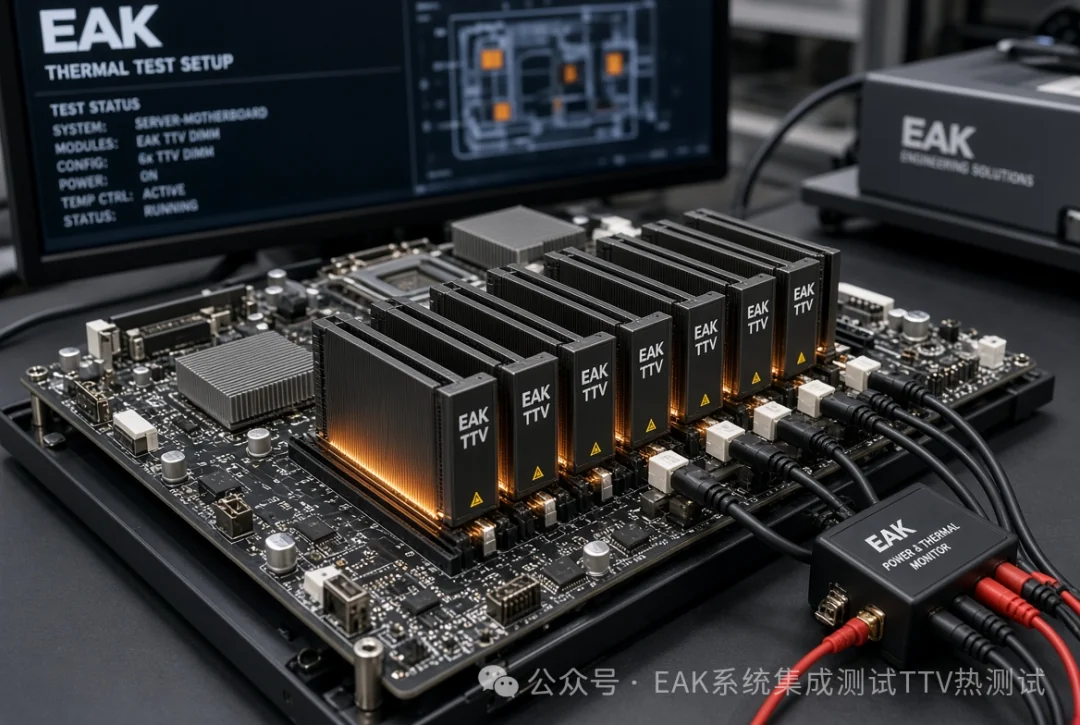
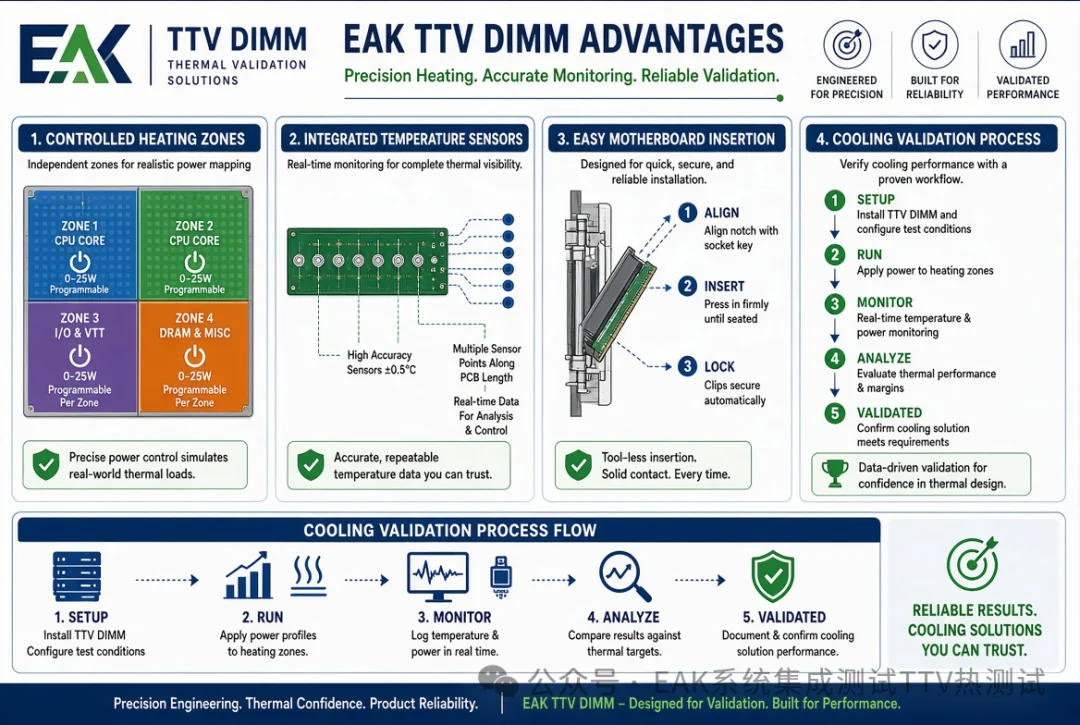
EAK TTV针对DIMM形态进行了优化,支持直接插入真实主板或专用Power Board,通过PMIC等方式控制功率,并实时读取电压、电流与温度数据。相比真实内存或简易加热片,优势明显:
- 精确可控功率
:支持单区或多区独立调节,可模拟均匀发热或局部热点,功率范围灵活覆盖实际工作场景(例如单根最高数十瓦级)。 - 高重复性与安全性
:内置温度传感器,数据精准可记录;不会因误操作损坏昂贵真实芯片。 - 系统级兼容
:可串接多根、与其他TTV协同,完整还原服务器运行环境;支持软件动态控制测试流程。 - 成本与效率优势
:可重复使用,降低测试成本,加速散热方案迭代与验证。
这些特性使工程师能快速获得热阻、温度分布、冷却性能等关键数据,而非依赖近似估算。
实际应用案例
案例1:服务器厂商散热优化
某服务器OEM在开发高密度AI节点时,使用EAK DIMM TTV插入主板,模拟32根DDR5模块在高带宽负载下的发热。通过调整功率与监测多点温度,优化了机箱风道与内存散热片设计,最终将关键区域温度降低了8–12°C,避免了降频风险。
案例2:液冷方案验证
冷却供应商利用EAK TTV配合冷板测试平台,验证内存区域液冷效果。TTV可精确设定不同功率密度,并与CPU TTV协同运行,帮助确认冷板接触热阻与流量分配是否满足满载需求,缩短了从原型到量产的验证时间。
案例3:数据中心机柜级热管理
在机柜测试中,多组EAK TTV(含DIMM与其他组件)模拟整柜热负载。工程师通过实时数据调整冷却回路参数,确保在极端工况下内存温度始终处于安全范围,为大规模部署提供可靠依据。
结语
随着AI服务器对内存带宽与密度的要求不断提高,DIMM散热已从“次要问题”变为系统可靠性的关键环节。EAK TTV通过精准、可控的发热模拟,让客户在安全、高效、低成本的条件下完成热验证,显著缩短开发周期并提升最终产品的稳定性。
无论是早期原型测试、散热方案选型,还是系统级集成验证,EAK TTV都是工程师手中可靠的热模拟工具。如需了解具体型号、功率规格或定制方案,欢迎进一步咨询。